




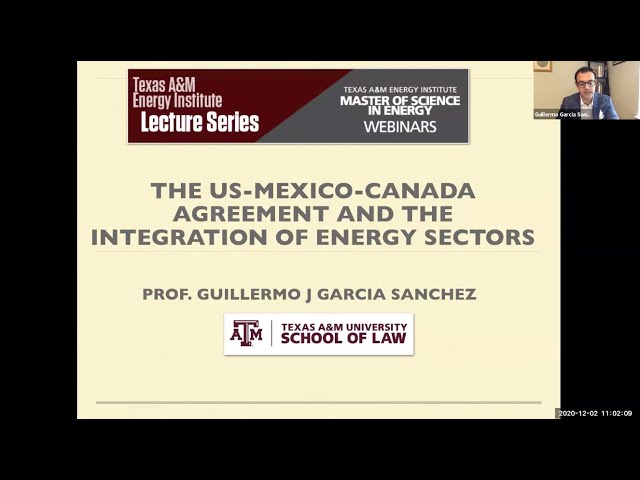
Understanding the US-Mexico-Canada Agreement (USMCA): Key Insights from Prof. Guillermo J. Garcia Sanchez
The Energy Institute Lecture Series featuring Prof. Guillermo J. Garcia Sanchez sheds light on the complexities of energy relations between the United States, Mexico, and Canada. This article delves into the evolution of the USMCA and its impact on foreign investment, energy reforms, and cross-border trade dynamics.
Summary Table
| Topic | Details |
|---|---|
| Event | Energy Institute Lecture Series |
| Presenter | Prof. Guillermo J. Garcia Sanchez |
| Main Focus | USMCA, foreign investment protections, energy sector reforms |
| Key Regions | United States, Mexico, Canada |
Historical Context: Mexico’s Nationalized Energy Sector
In 1938, Mexico nationalized its oil and gas industry under President Lázaro Cárdenas. This created PEMEX, a state-owned enterprise that managed production, exploration, and distribution. For decades, PEMEX controlled Mexico’s energy sector, shaping the nation’s approach to energy independence and nationalism.
The 1994 North American Free Trade Agreement (NAFTA)
NAFTA marked a significant step in economic integration among the US, Mexico, and Canada. However, Mexico’s energy sector was excluded due to domestic resistance to foreign investment. While NAFTA introduced mechanisms for foreign investor protections, the energy market remained under strict state control.
Energy Reforms of 2013
Facing declining oil production and financial strain on PEMEX, Mexico enacted sweeping energy reforms in 2013. Key changes included:
- Opening the energy sector to private and foreign investments.
- Allowing production-sharing and licensing agreements.
- Reducing PEMEX’s tax burden to enhance competitiveness.
- Establishing independent regulatory bodies for energy oversight.
These reforms attracted significant foreign investment but were implemented during a period of declining global oil prices.
The Transition to USMCA
USMCA, replacing NAFTA in 2020, reflected new trade dynamics and energy dependencies. Key updates included:
- Modifications to rules of origin for crude oil and refined products.
- Recognition of Mexico’s sovereign control over hydrocarbons (Chapter 8).
- Introduction of stricter foreign investment dispute mechanisms.
While the USMCA streamlined certain trade processes, the omission of a dedicated energy chapter limited its scope in addressing modern energy challenges.
Current Challenges Under AMLO’s Administration
Mexico’s current president, Andrés Manuel López Obrador (AMLO), has prioritized state control over energy resources. This has led to policies that favor PEMEX and CFE (Mexico’s Federal Electricity Commission) while revisiting existing contracts with private investors. Key initiatives include:
- Building new refineries to reduce reliance on imported gasoline.
- Revising energy contracts deemed unfavorable to the state.
- Halting new bidding rounds for private investment.
Future Outlook
As energy disputes between Mexico and foreign investors increase, the role of USMCA’s dispute resolution mechanisms will be critical. The treaty’s provisions aim to balance state sovereignty with foreign investor protections, creating a complex legal landscape for energy sector stakeholders.
Conclusion
The evolution of the US-Mexico-Canada Agreement highlights the intricate interplay between trade, investment, and energy policies. While the reforms and agreements have facilitated greater collaboration, ongoing challenges underline the importance of clear regulatory frameworks and mutual commitments to fostering sustainable energy growth.