




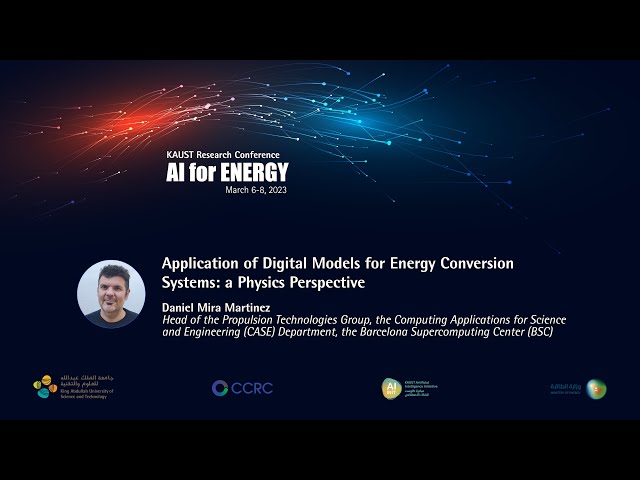
Application of Digital Models for Energy Conversion Systems: A Physics Perspective
Artificial intelligence and digital models are revolutionizing energy conversion systems. Dr. Daniel Mira Martinez, the head of the Propulsion Technologies Group at the Barcelona Supercomputing Center (BSC), offers a detailed insight into this transformative field during his talk titled “Application of Digital Models for Energy Conversion Systems: A Physics Perspective.” His expertise spans computational fluid dynamics (CFD), machine learning, and high-fidelity combustion simulations. In this article, we explore Dr. Mira’s discussion on digital modeling, energy systems, and challenges in integrating machine learning with CFD simulations. We’ll also summarize the key insights to provide an overview of this cutting-edge research.Why Digital Models Matter in Energy Systems
Energy systems, such as combustion processes, involve complex physical phenomena that are challenging to simulate. Digital models and machine learning are emerging as powerful tools to enhance these simulations by improving accuracy, reducing computational costs, and offering predictive insights. Dr. Mira emphasizes the role of computational power, particularly through supercomputers like BSC’s Marenostrum, in enabling these advancements. He also highlights the potential for machine learning to address challenges in turbulence, pollutant formation, and digital twin applications.Summary Table of Key Insights
| Topic | Insights |
|---|---|
| CFD and Machine Learning | Integrating machine learning models into CFD simulations improves pollutant prediction and turbulence modeling. |
| Challenges | Accessing reliable datasets, training machine learning models, and ensuring computational efficiency are significant obstacles. |
| Digital Twins | Digital twins enable real-time monitoring and optimization of complex energy systems, reducing the need for costly experiments. |
| Future Directions | Dr. Mira advocates for developing digital models with high-fidelity physics to address real-world energy system challenges. |